Intruder alarm maintenance software for contractors and their engineers.
Record the planned maintenance visit with its panel check, issue the certificate, and turn defects into quotes, from the engineer’s phone, offline.
From as little as £1 a day (Lite, billed yearly, plus VAT) · Early adopters lock their price for 3 years · No contract
Simple prices, per user per month plus VAT.
From as little as £1 a day (Lite, billed yearly, plus VAT). Anyone signing up in the first 12 months after launch locks their price for 3 years. No contract.
Stickers are £1 + VAT each, plus £3.95 + VAT postage per order. A log-book-only account is available for anyone with sites. Onboarding is from £195, quoted individually. Seats can be mixed in one company.
From the maintenance plan to the certificate and the quote.
Planned maintenance visits with a panel check
The intruder alarm planned preventative maintenance certificate includes a panel check: battery and charger readings, with the limits shown beside each reading, and a standby battery check. It is built around the intruder alarm standards, PD 6662 and BS EN 50131.
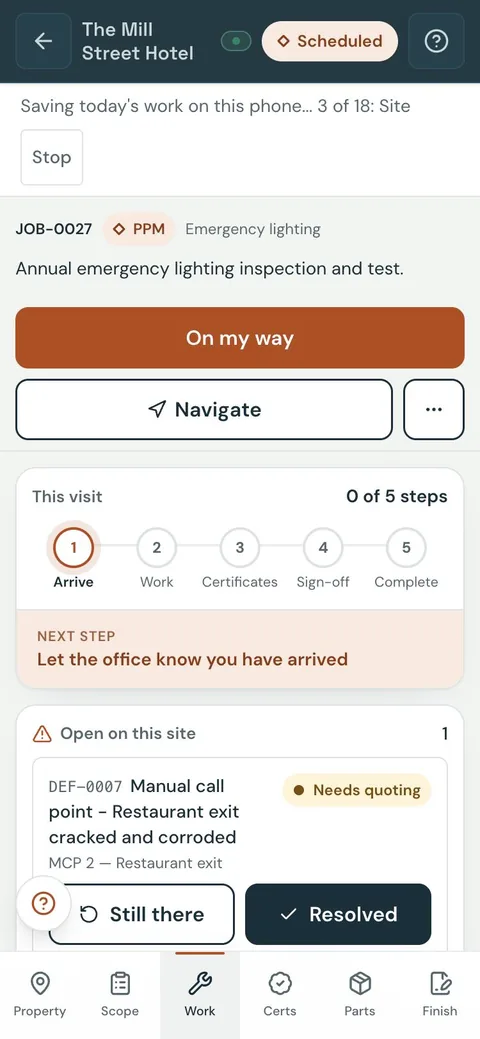
The engineer records the visit on site, collects the signature and emails the PDF to the customer.
Commissioning and installation records too
There are intruder alarm commissioning and installation completion templates, plus CCTV, access control and alarm signalling. The commissioning record says plainly that it is not a certificate issued under an inspectorate scheme, so it never looks like one.
Defects become quotes
Defects found on site are listed on the job with a Needs quoting status, go into a defect quote, and the customer can approve the quote from a link in the email.
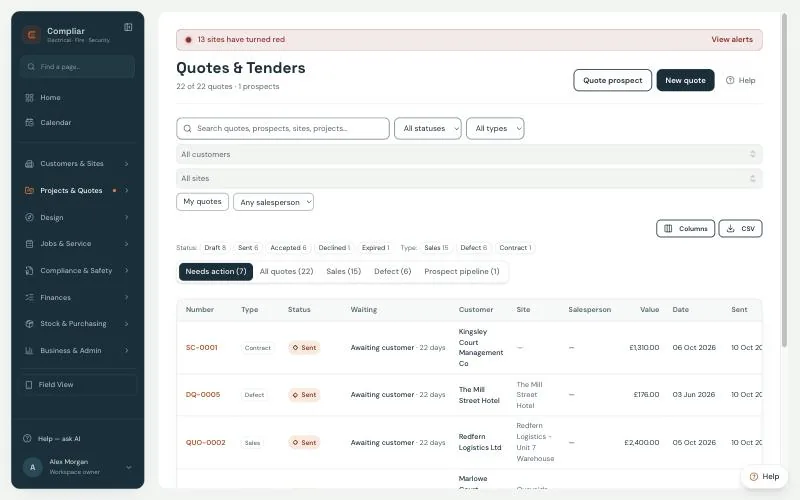
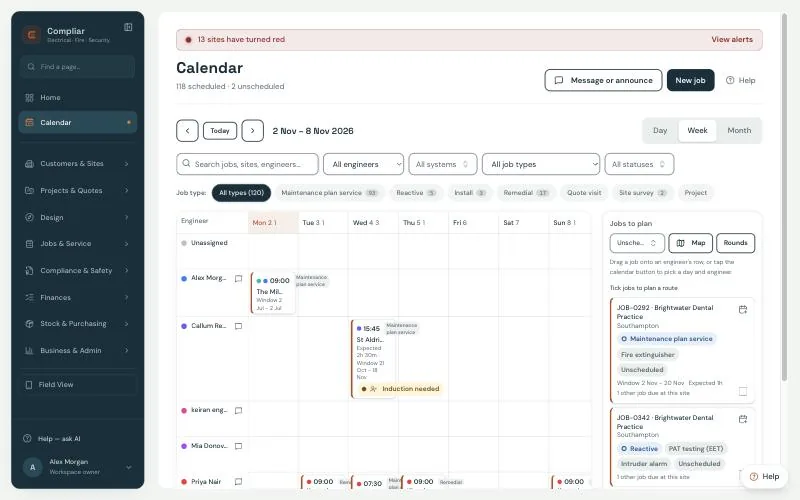
Screens show sample data. Compliar produces records; the engineer and the scheme remain responsible for the work and for the certificates issued. Compliar is not approved by or affiliated with any standards body or scheme.
A maintenance visit, in the order engineers do it
General guidance only. PD 6662 and the BS EN 50131 series set the requirements; check the edition your contract names and your scheme document. Last reviewed 3 November 2026.
How often
The usual pattern for a monitored intruder and hold-up alarm system is two maintenance visits a year, and for an audible-only system one. PD 6662 allows part of that routine to be done remotely for some systems, and your contract and scheme may say more. Compliar's maintenance plan holds the frequency per site, generates the routine jobs ahead of time and keeps the due date fixed, so a visit done early or late does not drift the cycle.
What the visit covers
- Panel and power. Mains present, charger output, standby battery voltage and condition, and the battery's age against its replacement date. The certificate shows the limits beside each reading, so an out-of-range value is obvious on the phone, not back at the office.
- Standby duration. The standby time a grade needs depends on the grade and on whether a mains failure is signalled. The intruder alarm battery calculator works the capacity through for Grade 2 and Grade 3.
- Every detector and contact. Walk test each zone, check tamper, and confirm masking and anti-masking where the grade requires it. Record a result per device so that a detector that was never walked is shown as not tested, not as a pass.
- Hold-up devices. Operate each one and confirm the signal, with the ARC on test.
- Signalling. Fire and fault signals both reach the alarm receiving centre; the path fault is reported; the ARC's reference and the keyholders on file are still right.
- Sounders and strobes. Internal and external devices operate, and the external sounder's own battery is checked where fitted.
- Settings and users. Time and date, user codes still appropriate, no engineer defaults left in, event log reviewed for repeated false activations.
Worked example
On the Harbourview sample site a Grade 3 system has 14 detectors across six zones, a hold-up button at reception and a dual-path signalling unit. On the six-monthly visit the engineer walks each zone from the phone, marking Pass or Fail per device; the panel readings go in with the limits shown; the ARC is put on test using the monitoring details held against the site; the hold-up button is operated and the signal confirmed. A PIR in the stock room fails its walk test twice. It is marked Fail with a photo, becomes a defect with a Needs quoting status, and the office raises a defect quote that evening. The certificate goes to the customer as a PDF from the job, with the two open defects shown.
Common mistakes
- Copying last visit's readings. Battery voltage drifts; the point of the record is the trend.
- Walk-testing from the panel log only. A detector that reports to the panel can still be misaligned or masked.
- Forgetting to take the system off test. Record the on and off times on the visit.
- Leaving the defect in the notes. A fault written in free text never becomes a quote. Raise it as a defect so it is tracked to resolved.
- Certificates that look like scheme certificates. Compliar's intruder records say plainly that they are your own record and not a certificate issued under an inspectorate scheme.
See also the grades and maintenance guide, what a Grade 3 system is, and the records a scheme audit asks for.
Common questions
What does the intruder alarm maintenance certificate record?
The visit, the panel check readings with their limits, the standby battery check, the zone and device tests and any defects, ready to sign and send.
Does it work without a signal?
Yes. The field app keeps today’s work on the phone and queues changes until the phone is back online.
Is the commissioning record an inspectorate certificate?
No. It is your own record of the commissioning and says so. Compliar is not approved by or affiliated with any standards body or scheme, and the engineer remains responsible for the work.
How often should an intruder alarm be maintained?
The usual pattern is two visits a year for a monitored system and one for an audible-only system, with PD 6662 allowing part of the routine to be done remotely for some systems. Check the edition your contract names and your scheme document.
Can I put the ARC on test from the app?
The site's monitoring and ARC details are held against the site and shown on the job, so the engineer has the reference and number to hand. Note the on-test and off-test times on the visit; Compliar does not connect to the ARC itself.
Does the certificate show the battery limits?
Yes. The panel check shows the charge voltage limits beside each reading, so an out-of-range value is visible on the phone, and the standby battery check sits on the same certificate.
Can engineers see the site's history on the phone?
Yes. The job shows the site's open defects and previous visits, so the engineer knows what was found last time before they start.
What does it cost?
Lite is £35 per user per month plus VAT, or £350 plus VAT paid yearly, which is about £1 a day. Office is £65 and Design is £95. There is no contract and no per-certificate fee.
See it on your own sites.
Complete the form below and we’ll get back to you as soon as possible to arrange your live walkthrough.